
The Australian monetary system has evolved from colonial times to the modern decimal system introduced in 1966.
The rarity of specific specimens from the Rare Australian Coins List results from limited mintages, design changes, or the withdrawal of certain series from circulation.
The Royal Australian Mint (RAM) and the Perth Mint serve as the primary producers providing legal tender coinage.
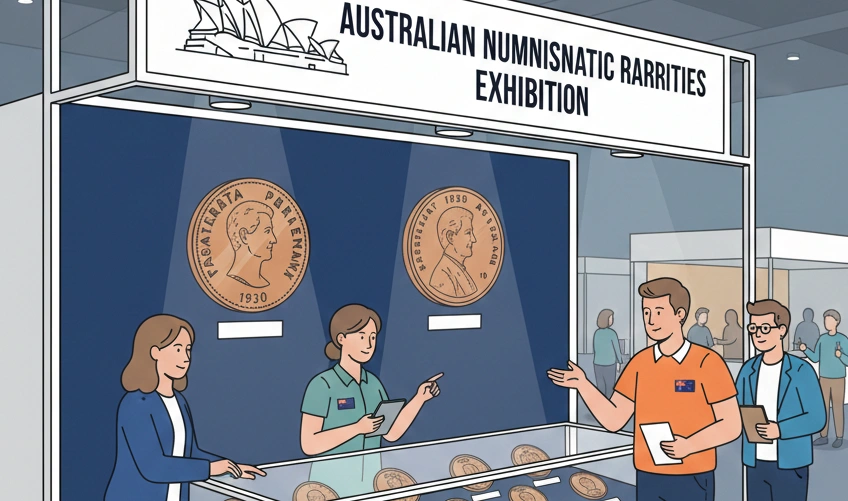
The 1813 Holey Dollar
The first official currency created in the colony of New South Wales represents modified Spanish dollars.
Governor Lachlan Macquarie ordered the removal of the central part from each coin to prevent the export of currency from the colony.
Two parts formed as a result: the outer disk (Holey Dollar) and the inner disk (Dump).
The total number of manufactured specimens reached 40,000 units.
Approximately 300 specimens of the outer ring have survived to the present day.
Parameter | Holey Dollar (Outer Ring) | Dump (Inner Disk) |
1813 Denomination | 5 Shillings | 15 Pence |
Metal | Silver | Silver |
Weight (Average) | ~20 grams | ~6 grams |
Record Price | 550,000 AUD (2015) | 250,000 AUD (2018) |
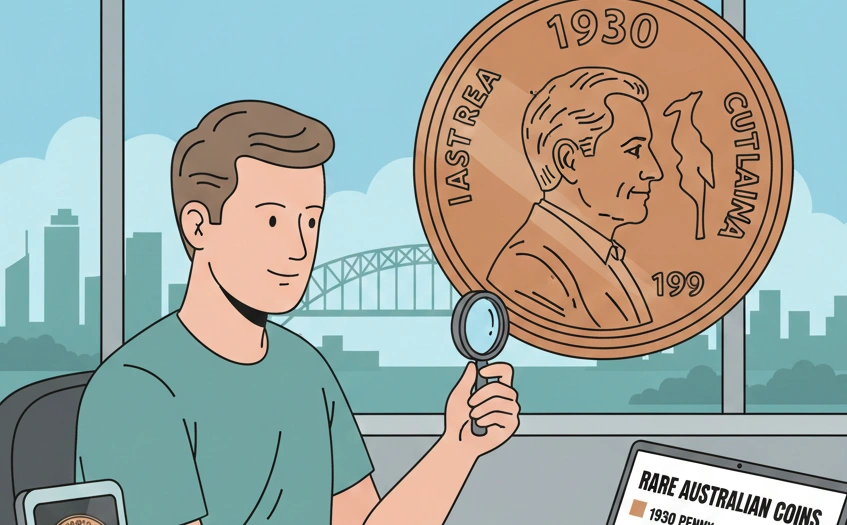
The 1930 Australian Penny
This coin is considered the most famous rarity in pre-decimal Australian numismatics.
Official records of penny mintage in 1930 at the Melbourne Mint do not exist.
Coins were produced as trial specimens or resulted from technical failures involving dies from previous years.
Experts estimate that no more than 1,500 – 3,000 specimens entered circulation.
The value of the 1930 penny demonstrates steady growth averaging 7–10% per year over the last two decades.
In 2019, a Proof specimen sold at a private auction for 1,150,000 AUD.
Ordinary specimens possessing circulation marks trade in the range of 15,000 to 35,000 AUD.
Grade | Estimated Price (AUD) | Price Change (5 Years) |
Very Fine (VF) | 25,000 | +40% |
Extremely Fine (EF) | 55,000 | +35% |
About Uncirculated (AU) | 120,000 | +25% |
The 1910 Florin (Edward VII)
The 1910 Florin represents the first coin of this denomination issued specifically for Australia.
Production occurred in London using dies featuring the portrait of King Edward VII.
The mintage totaled 1,250,000 units, yet the preservation of most coins worth money in Uncirculated condition is extremely rare.
The silver composition (92.5% silver) contributed to rapid surface wear during intensive circulation.
The record price for a specimen in MS66 grade stands at 32,000 AUD.
1970 50 Cents Captain Cook
After the transition to the decimal system in 1966, commemorative coins began to be issued.
The 1970 50-cent coin, dedicated to the 200th anniversary of James Cook's voyage, has several rare variants.
The standard coin is made of copper-nickel alloy with a circulation of 16.5 million copies.
The version minted on a pure silver piece, intended for VIP presentations, is a rarity.
The value of such specimens exceeds 5,000 AUD.
Two-Dollar Coins with Color Design
Starting in 2012, Australia began issuing 2-dollar coins featuring colored enamel on the reverse.
The 2012 "Red Poppy" coin dedicated to Remembrance Day is considered one of the most valuable.
The mintage totaled only 500,000 units, ensuring rapid growth in market value.
Coin | Mintage (pcs) | Issue Price (AUD) | Price Today (AUD) |
2012 Red Poppy | 500,000 | 2.00 | 350 – 500 |
2013 Purple Coronation | 1,000,000 | 2.00 | 120 – 180 |
2015 Red Anzac Cove | 1,460,000 | 2.00 | 60 – 90 |
Minting Errors
Manufacturing errors create unique lots valued significantly above face value.
2000 $1/10c Mule
An error occurred at the Royal Australian Mint in 2000.
An employee used an obverse die from a 10-cent coin to strike a 1-dollar coin.
This resulted in a coin featuring a characteristic double rim on the side with the Queen's portrait.
Discoveries of such coins in circulation continue, but their number is limited to several thousand.
The market price varies from 400 AUD (worn) to 4,000 AUD (Mint condition).
Off-center Strikes
Displacement of the planchet during the die strike leads to "crescent-shaped" coins.
The price depends on the displacement percentage and the preservation of the issue date.
A 20% displacement increases the value of a standard 50-cent coin to 200–300 AUD.
Return Statistics for Rare Coins
Investing in Australian coins requires an understanding of long-term trends.
Analysis of data over the last 30 years shows that rare coins outperform the gold price index in terms of returns.
Average annual price growth for rarities (Top 100): 8.4%.
Price decline during crisis periods: no more than 10–12% (unlike stocks).
Price increase upon the change of a monarch: +15% within the first year (recorded in 2023).
Identifying Valuable Specimens
Coin verification requires using tools for microscopic analysis.
Using the best coin value app allows for identifying traces of repunched dates or die defects.
Critical areas for checking include:
The mint mark (usually small letters on the reverse).
The number of pearls in the monarch's crown (for pre-decimal coins).
The spacing between letters in the coin legend.
Denomination | Rare Year | Mintage (pcs) | Expected Price (UNC) |
1 Penny | 1925 | 1,176,000 | 1,200 AUD |
3 Pence | 1923 | 632,000 | 2,500 AUD |
1 Shilling | 1933 | 200,000 | 3,800 AUD |
2 Shillings | 1932 | 188,000 | 6,500 AUD |
Conclusion
The rare Australian coin market is characterized by high transparency and the availability of detailed catalogs.
Coin value forms exclusively based on physical preservation and confirmed mintage rarity.
The absence of new finds in the pre-decimal segment guarantees price stability for owners of high-grade specimens.
Professional certification (PCGS/NGC) remains a mandatory condition for realizing coins at record prices.
Searching for hidden treasures in modern circulation requires focusing on commemorative 2-dollar issues and technical minting errors.